
4/8-Port OptiTap-Compatible Fiber Access Terminal
Product Overview
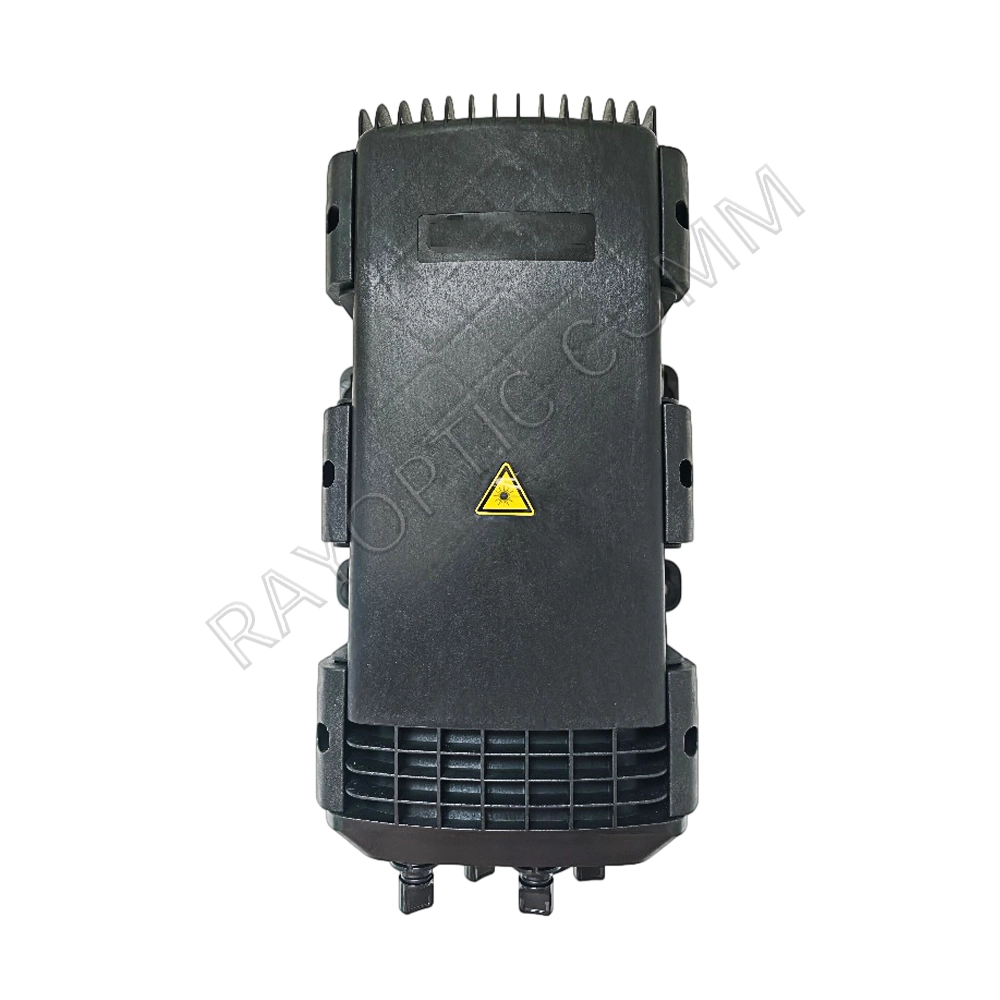
The Rayoptic 4/8-Port OptiTap-Compatible Fiber Access Terminal is designed as an outdoor connection point between feeder fiber cables and pre-connectorized subscriber drop cables.
The enclosure combines feeder cable termination, fiber splicing, PLC splitting, fiber storage and hardened drop cable connections in one compact unit. Up to eight hardened SC/APC OptiTap-compatible adapters can be installed, while four-port and eight-port versions cover the most commonly used FTTH deployment requirements.
Two internal fiber configurations are available. The PLC splitter version divides one feeder fiber into four or eight subscriber outputs, making it suitable for distributed split FTTH architectures. The feeder cable splice version connects individual feeder fibers directly to the hardened adapter pigtails without using an optical splitter.
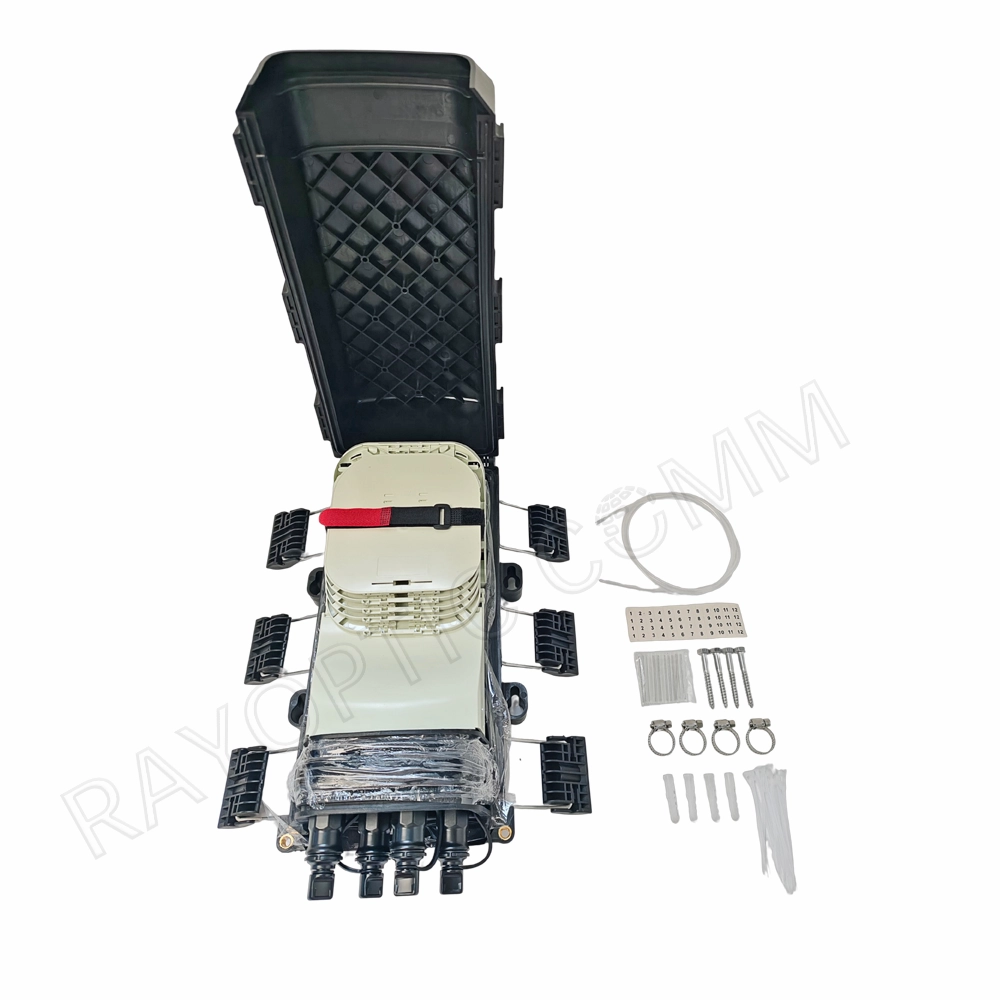
The IP68-rated polypropylene enclosure protects internal fibers and components against dust, water and demanding outdoor conditions. Its removable splice trays and organized fiber routing simplify installation, maintenance and future network expansion.
Fetures
- Supports up to 8 hardened SC/APC OptiTap-compatible adapters
- Available with 4 or 8 subscriber service ports
- PLC splitter and feeder cable splice configurations available
- Optional pre-installed 1×4 or 1×8 PLC splitter
- IP68-rated enclosure for outdoor FTTH installations
- Integrated fiber splicing, splitting, storage and distribution
- Removable stacked splice trays for easier installation and maintenance
- Separate fiber routing and storage areas help protect fiber bend radius
- Durable polypropylene enclosure with good mechanical strength
- Supports feeder cable and drop cable entry and fixation
- Suitable for wall-mounted and pole-mounted installations
- Plug-and-play connection for pre-connectorized FTTH drop cables
Technical Specification
| Product Type | Outdoor Fiber Access Terminal |
Number of Service Ports | 4 or 8 |
| Maximum Adapter Capacity | 8 |
Dimensions(HxWxD)(mm) | 365 × 195 × 133 |
Adapter Type | Hardened SC/APC, OptiTap-compatible |
Internal Configurations | PLC splitter or feeder cable splice |
| Splitter Options | 1×4 PLC or 1×8 PLC |
| Maximum Splice Capacity | Up to 66 fibers |
| Enclosure Material | Engineering-grade polypropylene |
| Ingress Protection | IP68 |
| Maximum Cable Entry Diameter | 2 × 16 mm and 2 × 11 mm |
| Installation Methods | Aerial mounting,Wall mounting and pole mounting |
Ingress Protection | IP68 |
Operating Temperature | -40~+75 ℃ |
Available Configurations
Configuration Selection
PLC Splitter Configuration
The PLC splitter configuration is supplied with a 1×4 or 1×8 PLC splitter. One incoming feeder fiber is divided into four or eight optical outputs, which are connected to the hardened SC/APC subscriber ports.
This configuration is suitable for distributed split FTTH networks where optical splitting is performed close to subscribers.
Feeder Cable Splice Configuration
The feeder cable splice configuration does not include an optical splitter. Individual feeder fibers are fusion-spliced directly to the pigtails of the hardened SC/APC adapters.
This configuration is suitable for point-to-point networks, centralized split architectures and applications where optical splitting is completed at another network location.
Configuration | Service Ports | Internal Connection | Recommended Application |
4-Port Splitter | 4 | Pre-installed 1×4 PLC splitter | Four-subscriber distributed split point |
4-Port Splice | 4 | Feeder fibers spliced directly to adapter pigtails | Point-to-point or externally split networks |
8-Port Splitter | 8 | Pre-installed 1×8 PLC splitter | Eight-subscriber distributed split point |
8-Port Splice | 8 | Feeder fibers spliced directly to adapter pigtails | Point-to-point or externally split networks |
Application
- FTTH and FTTx access networks
- Passive Optical Networks
- Rural broadband deployments
- Outdoor fiber distribution points
- Distributed split FTTH architectures
- Centralized split FTTH architectures
- Feeder-to-drop cable transition points
- Residential and commercial subscriber access
- Wall-mounted and pole-mounted fiber distribution


 English
 Spanish