

In FTTH deployment, the choice of a ROC drop cable can directly affect installation efficiency, field handling, and long-term network performance. For installers, contractors, and broadband project managers, the ideal cable is not simply one that meets a basic specification. It should also be practical to use in real outdoor environments, easy to carry, and reliable in optical transmission.
As fiber networks continue to expand in residential, rural, and last-mile broadband projects, there is increasing demand for fiber optic drop cables that support faster installation without sacrificing performance. A well-designed micro flat drop cable should help simplify field work, reduce handling difficulty, and maintain stable optical results after installation.

So, what exactly makes a ROC drop cable ideal for easy and reliable field installation? Below are four important features worth paying attention to.
1. Easy Access to the Fiber for Faster Field Work
One of the most important qualities in a field-installation fiber cable is how easily the inner fiber can be accessed. In outdoor construction, technicians often need to prepare the cable quickly on site. If the cable structure is difficult to open or strip, installation takes longer and becomes less convenient, especially when working under time pressure or in less controlled jobsite conditions.
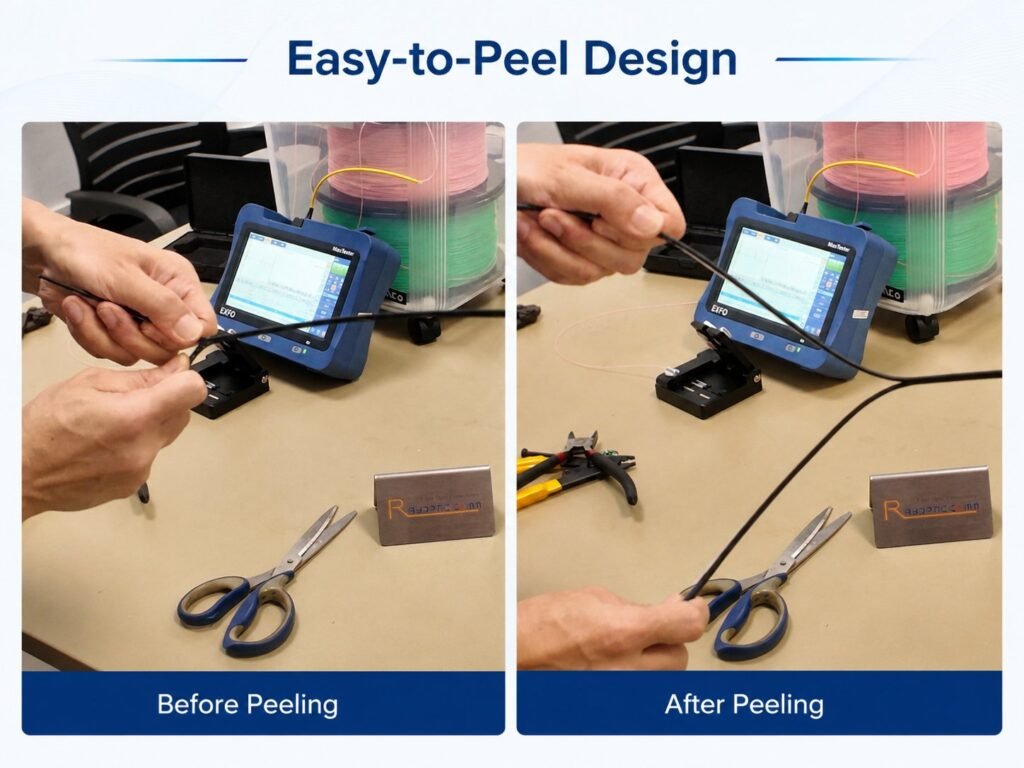
That is why an easy-to-peel design is highly valuable. A ROC drop cable with separable strength members allows installers to expose the inner 0.9 mm tight-buffered fiber more efficiently. This can help save time during preparation and reduce unnecessary difficulty during splicing, routing, or termination.
In practical terms, easier fiber access supports quicker cable preparation, simpler field handling, improved efficiency during outdoor installation, and smoother last-mile connection work.
This is also one of the clear strengths of Rayoptic’s ROC drop cable. Its FRP strength members can be separated by hand, making it easier to access the tight-buffered fiber inside. For installers who value fast and straightforward handling, this structure offers a practical advantage in real deployment environments.
2. Fiber Options That Match Different Project Needs
Another important factor is fiber selection. Not every project has the same requirements, and not every customer prefers the same fiber brand. In many FTTH deployment and broadband installation projects, buyers pay close attention to fiber performance, compatibility, and brand preference when selecting a single-mode fiber drop cable.
An ideal micro flat drop cable should therefore offer flexibility in fiber options. This is especially useful when a project must align with existing network standards, customer preferences, or specific bend-performance needs. Well-recognized fiber brands can also give customers greater confidence in the cable’s long-term use.
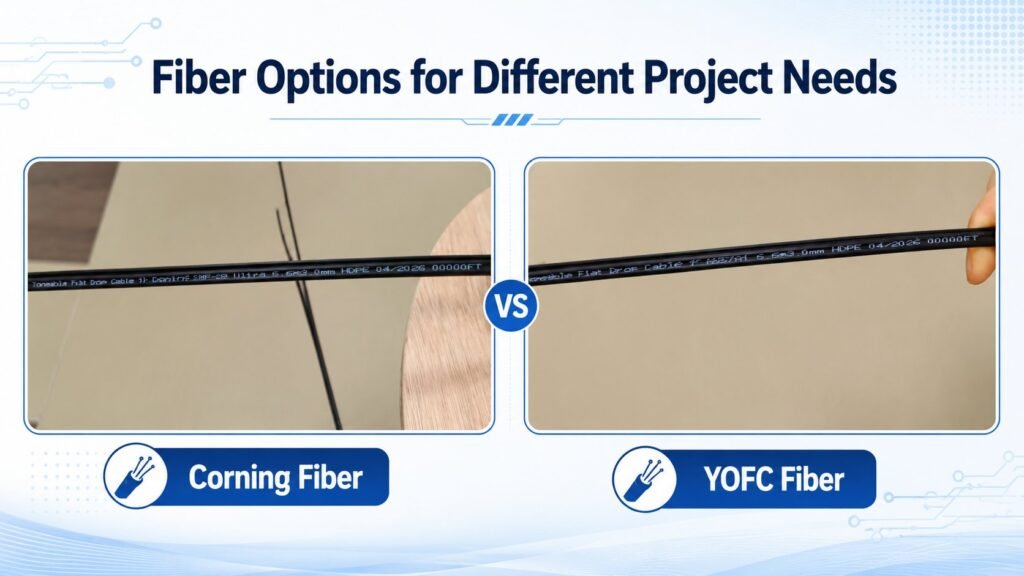
Fiber options such as YOFC EasyBand® Ultra Bending Insensitive Single-mode Fiber and Corning SMF-28® Ultra Fiber are often valued because they are familiar to the market and trusted in many network applications. Offering this kind of flexibility makes a cable more adaptable across a wider range of deployment scenarios.
Rayoptic’s ROC flat drop cable reflects this practical approach by offering fiber options that include YOFC EasyBand® Ultra Bending Insensitive Single-mode Fiber and Corning SMF-28® Ultra Fiber. This gives customers more flexibility when choosing a cable for different project standards and application needs.
3. Packaging That Makes Outdoor Installation Easier
Cable structure matters, but packaging also plays a major role in field efficiency. In many cases, installers are not just evaluating the cable itself. They are also thinking about how easy it is to transport, carry, and deploy at the jobsite. For outdoor broadband construction, a cable that is awkward to move can slow down the work even before installation begins.
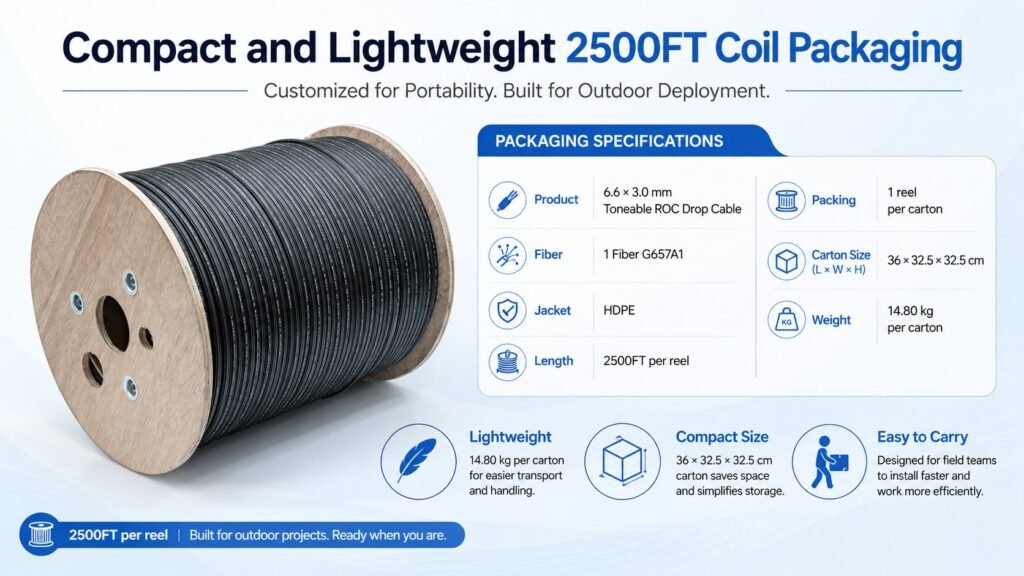
That is why a compact and lightweight fiber cable coil format can be a strong advantage. A customized coil length can help meet project requirements while making the cable easier to handle in the field. For example, a 2500-foot coil can be practical for certain outdoor installation jobs where portability, storage, and deployment convenience all matter.
A lightweight and compact coil can help with easier carrying on site, more convenient transportation, more efficient cable payout, and reduced handling burden for installation crews.
Rayoptic’s product shows a clear field-oriented advantage. It is available in a customized 2500-foot coil designed to be lightweight, compact, and easier to carry for outdoor installation. For project teams that care about portability and practical deployment, this packaging format can be just as valuable as the cable design itself.
4. Reliable Low-Loss Performance in Real Applications
No matter how easy a cable is to handle, it still needs to perform well optically. Reliable transmission is one of the core requirements for any fiber optic cable for field installation. If a cable cannot maintain stable optical performance, installation convenience alone is not enough.
That is why low-loss performance is a key part of what makes a ROC drop cable truly suitable for FTTH and outdoor deployment. Stable attenuation performance helps support signal integrity and contributes to the reliability of the overall network. In practical network construction, this matters for both initial installation quality and long-term service performance.
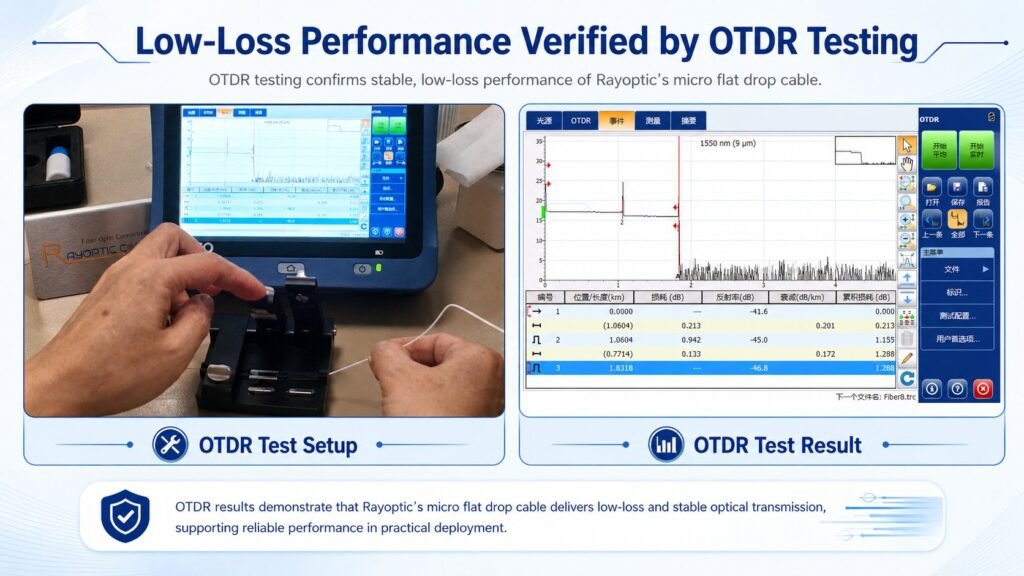
OTDR test results are one of the useful ways to verify this. When a cable demonstrates low-loss performance through OTDR test results, it gives installers, engineers, and buyers more confidence that the product can support dependable transmission in the field.
Rayoptic’s micro flat drop cable is designed with this requirement in mind. Its low-loss performance has been demonstrated through OTDR test results, helping show that the cable is not only easy to handle, but also capable of stable optical transmission in practical use.
Choosing a ROC Flat Drop Cable That Supports Real Field Needs
When evaluating a ROC drop cable, it is important to look beyond basic specifications. The ideal cable for easy and reliable field installation should combine practical handling, flexible fiber options, convenient packaging, and dependable optical performance.
In summary, four features make a strong difference: easy access to the inner fiber, trusted fiber options for different project requirements, lightweight and practical coil packaging, and low-loss performance supported by testing.
A cable that combines these features can help improve installation efficiency while also supporting stable network performance after deployment.
For customers looking for a micro flat drop cable that fits real-world FTTH construction needs, these are the details worth paying attention to. And in these same areas, Rayoptic’s solution offers practical advantages that align well with the demands of outdoor field installation.
For a more visual look at these features, watch the video below. It shows how the cable is easily peeled for quick fiber access, how the customized 2500-foot coil improves handling in the field, and how stable low-loss performance is confirmed through OTDR testing.


 English
 Spanish