
The global fiber-optic industry is advancing rapidly, yet the “last mile” remains one of the most challenging stages of deployment. Traditional FTTH installations often require on-site splicing, bulky closures, and highly trained technicians—leading to longer installation cycles and higher project costs.
Driven by the growing demand for faster and more reliable broadband, the MST Fiber Terminal has emerged as a transformative solution. Designed for the drop segment of FTTH networks, MST hardware simplifies installation, improves reliability, and speeds up network rollouts.
In many modern FTTH architectures, the efficiency of an MST Fiber Terminal is further enhanced by integrating a built-in PLC splitter directly inside the enclosure. By performing optical signal splitting at the terminal level, network operators can reduce splicing points, simplify network topology, and support true plug-and-play drop connections in the field.
To better understand how this integrated PLC splitter design works in practice—and why it is increasingly adopted in FTTH access networks—you may find our related article helpful:
What Is a Fiber MST Terminal with Built-In PLC Splitter?

FTTH solution illustrating how Rayoptic MST terminals and hardened drop cables connect homes through a plug-and-play outdoor network.
At Rayoptic, we summarize the value of hardened fiber terminal solutions in three core points:
An MST Fiber Terminal — also called a fiber terminal box, MST fiber enclosure, or Fiber Terminal (Hardened) — is a compact outdoor distribution unit that connects the feeder cable to multiple drop cables leading to end users.
In short, it is the bridge between your fiber distribution network and customer homes.
Compared with traditional splice closures, the Multi-Service Terminal offers faster deployment, higher reliability, and greatly simplified maintenance.
Feeder Cable → MST Fiber Terminal → Hardened Drop Cable → ONT
Inside the fiber terminal box:
This plug-and-play design ensures:
The IP68 hardened housing enables installation on poles, walls, pedestals, or inside hand-holes—ideal for all FTTH outdoor architectures.
A standard two-person crew can install an 8-port hardened terminal in under two hours — often up to 70% faster than conventional splice boxes.
When paired with Rayoptic hardened drop cables, overall FTTH deployment cost can drop by 20–25%.
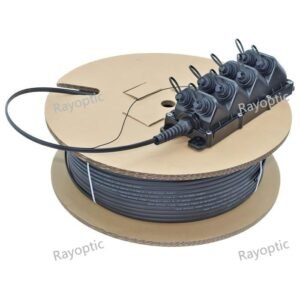
MST Fiber Terminal on Cardboard Reel – OptiTap Compatible Drop Cable Assembly
With a service life of over 20 years, MST terminals provide stable long-term outdoor performance.
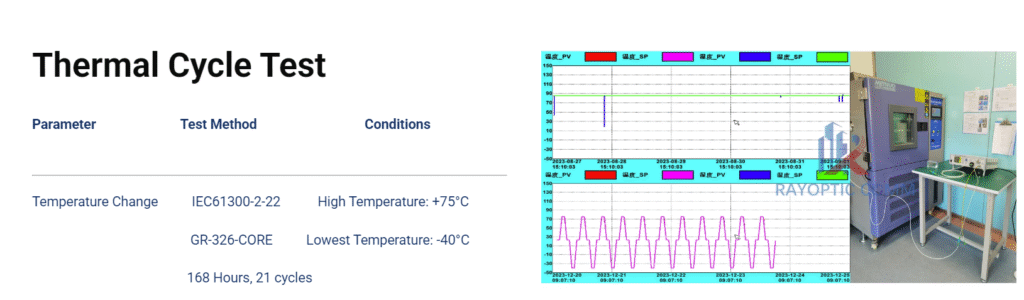
Thermal cycle test results showing high-low temperature curves and the environmental chamber used for fiber optic reliability testing.

Rayoptic multi-port MST fiber terminals in 2–8 port options for outdoor FTTH plug-and-play deployment
Full compatibility with Rayoptic hardened drop cables
Wall- or pole-mounted terminals supporting fast connections in apartment buildings and gated communities.
Pedestal-mounted MST terminals supporting long-distance drops across farms and remote villages.
Mounted on utility poles or walls to shorten drop lengths and simplify distribution.
Ideal for underground networks requiring moisture-proof and accessible terminal points.
For ISPs, faster installation means earlier service activation and quicker ROI.
This approach is especially effective for FTTP/FTTH and industrial park deployments.
Since 2020, Rayoptic has been designing and producing MST fiber terminals with continuous technology upgrades. We now export over 20,000 MST units annually to customers across North America, Europe, and Latin America.
This growth demonstrates that:

Rayoptic MST fiber terminal and hardened drop cable assemblies prepared for FTTH network deployments.
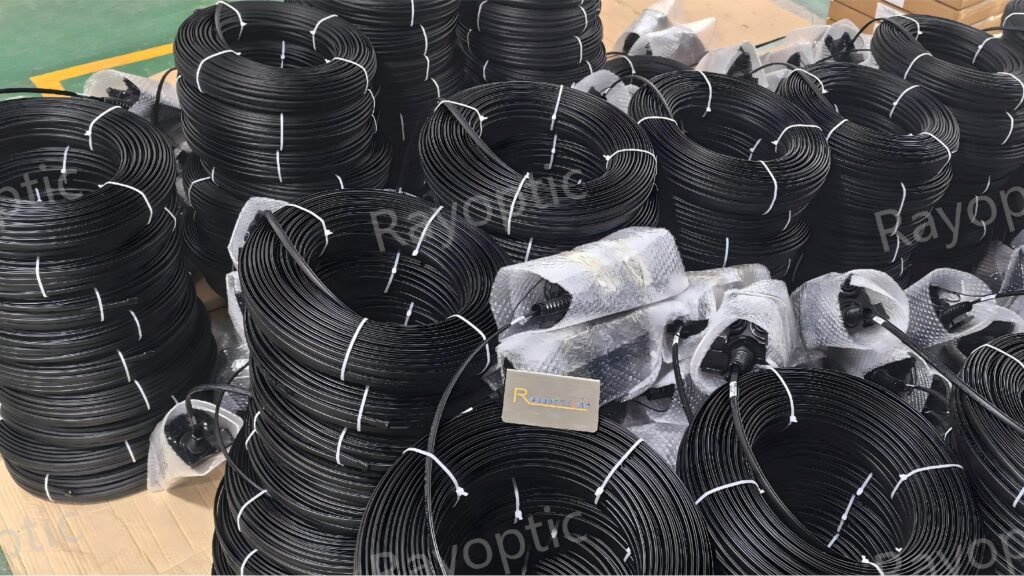
Bulk production of Rayoptic pre-terminated hardened drop cables for outdoor FTTH projects.
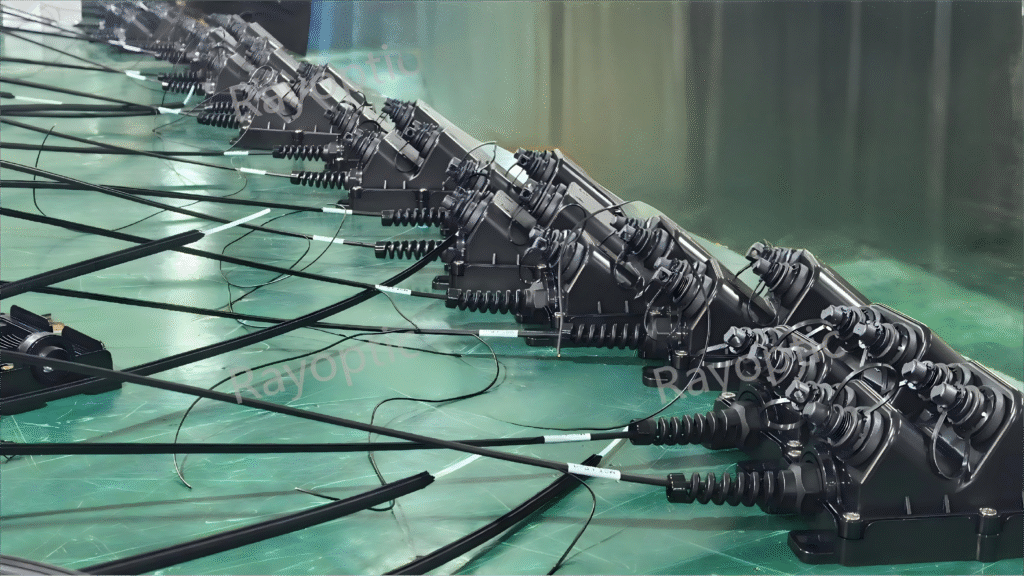
Rayoptic MST fiber terminals in batch production, equipped with hardened SC/APC connectors for outdoor FTTH networks.
Rayoptic MST terminals integrate perfectly with our hardened drop cable series, providing a complete plug-and-play FTTH solution.
We also provide full customized FTTH solutions — from sample development to mass-production support.
The MST Fiber Terminal — whether referred to as a fiber terminal box, an MST fiber enclosure, or a Multi-Service Terminal — is one of the most influential innovations in modern FTTH deployment.
MST solutions help operators:
With 20,000+ units exported annually, Rayoptic MST products are trusted by global ISPs and systems integrators.


 3F, Building E, Dahong Science Park,
Baihua Community, Guangming District,
Shenzhen, Guangdong 518107, China
 English English
 Spanish
