

Once a fiber optic cable route has been backfilled, finding a buried joint or branch point can become a difficult maintenance task. Installation drawings provide essential information, but crews also need a practical way to locate specific points in the field.
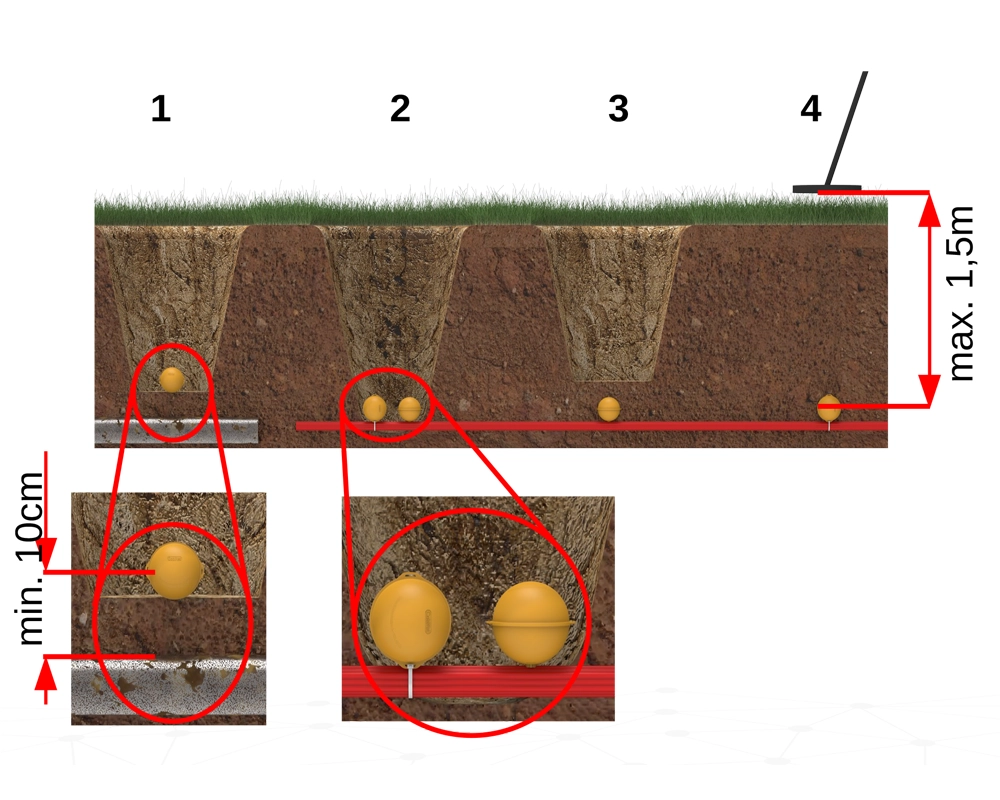
An underground electronic marker ball provides a detectable reference at these locations, helping maintenance teams find the marked position from above ground using a compatible locator.
Rayoptic now supplies underground marker balls for telecommunications infrastructure projects. This article introduces the orange 101.4 kHz configuration and explains how it can support the installation and maintenance of buried fiber optic networks.
What Is an Underground Marker Ball?
An underground marker ball is a passive electronic marker installed at a selected position before backfilling. It contains a resonant circuit that can be detected by a locator operating at the appropriate frequency.
The marker itself requires no battery or external power connection. Its role is to identify a specific buried location, such as a cable joint or branch point.
For fiber optic networks, this provides a useful reference where the position of a buried component needs to be found again during maintenance, repairs, or network expansion.
Where Can Marker Balls Be Used?
Marker balls can be placed at important points along a buried telecommunications route, including:
- Cable joints and splice locations.
- Branch points.
- Selected cable or duct positions.
- Other locations requiring a detectable underground reference.
The locations should be selected according to the network design and the operator’s maintenance requirements. Recording each marker’s position and purpose in the installation documentation helps future crews understand what they are locating.
Why Use a Self-Leveling Marker Ball?
The orientation of the internal locating coil matters during detection. A self-leveling marker ball allows the coil to align horizontally inside the housing.
This feature helps establish the intended coil orientation even when the outer ball is placed at an angle. It is useful during installation, when maintaining a precise housing orientation may be difficult.
The spherical housing also includes two lateral attachment brackets, allowing the marker to be secured at the selected position.
Key Specifications of the Orange 101.4 kHz Configuration
| Parámetro | Especificación |
| Marker type | Passive electronic marker ball |
| Color | Naranja |
| Operating frequency | 101.4 kHz ± 2.5 kHz |
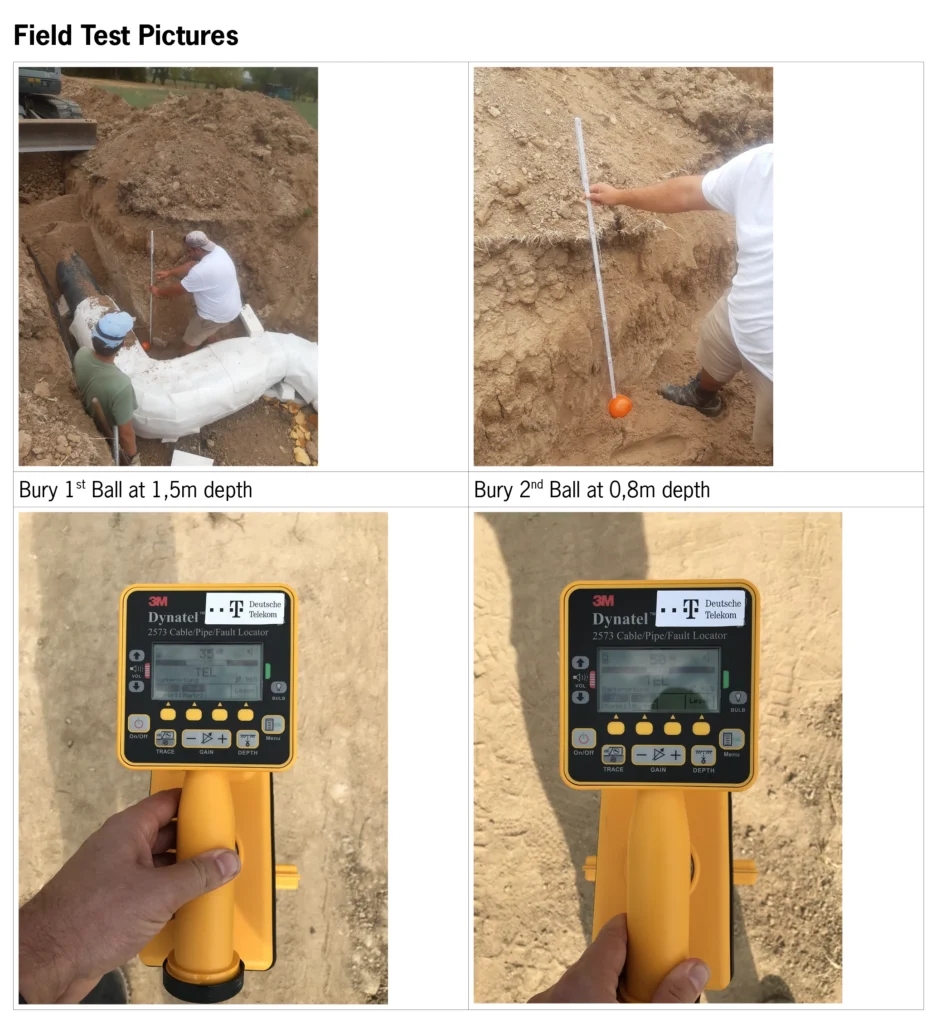
| Locating depth | Up to 1.5 m |
| Coil alignment | Automatic horizontal self-leveling |
| Housing material | HDPE |
| Ball diameter | Approximately 110 mm |
| Overall width, including brackets | 125 mm |
| Peso | Approximately 0.4 kg |
| Operating temperature | −15°C to +60°C |
| Storage temperature | −40°C to +75°C |
The stated locating depth is a product specification. Actual detection performance depends on the locator, installation conditions, and site environment. Confirm the supplied configuration and project requirements when ordering.
What Should You Check Before Installation?
Match the Marker to the Locator
The locator must support the marker’s operating frequency. For the configuration described here, check for compatibility with 101.4 kHz markers before installation.
Color alone should not be used to confirm compatibility. Verify the frequency on the product specification and the locator settings.
Plan the Burial Position
Install the marker at the intended reference point and within the specified locating depth. Consider how the crew will access and scan the area after the project is complete.
Check Detection Before Backfilling
Use the intended locator to check the marker response before covering it. This provides an opportunity to confirm compatibility and placement while the installation remains accessible.
Keep a Clear Installation Record
Record the marker location, frequency, and the component or feature it identifies. Marker balls and installation records work together to support future maintenance.
Source Marker Balls from Rayoptic
Rayoptic now supplies marker balls for underground telecommunications applications, helping customers include detectable reference points in their fiber optic infrastructure projects.
If you are sourcing marker balls for a new installation or an upcoming network expansion, contact Rayoptic with your required frequency, locator model, burial depth, and quantity.
Contact Rayoptic to discuss your marker ball requirements and request a quotation.


 English
 Spanish