
¿Qué es un terminal MST de fibra con divisor PLC incorporado?
As fiber broadband networks continue to expand across residential, commercial, and industrial environments, network operators are facing increasing pressure to deploy faster, maintain long-term reliability, and control operational costs. In modern FTTH and PON architectures, Fiber MST terminals with built-in PLC splitters have become a practical and widely adopted solution for last-mile fiber access.
A MST Box (Multi-Service Terminal) integrates fiber distribution, optical signal splitting, and hardened drop cable connectivity into a single compact outdoor enclosure. By incorporating a PLC splitter directly inside the terminal, service providers can significantly simplify field installation, reduce the number of splicing points, and accelerate subscriber activation.
For network planners working on FTTH rollouts, PON expansions, or last-mile fiber upgrades, understanding what a Fiber MST terminal is, how it works, and how different configurations affect deployment is essential. This article explains the fundamentals of Fiber MST terminals and serves as a foundation for deeper discussions on configuration selection and network design.
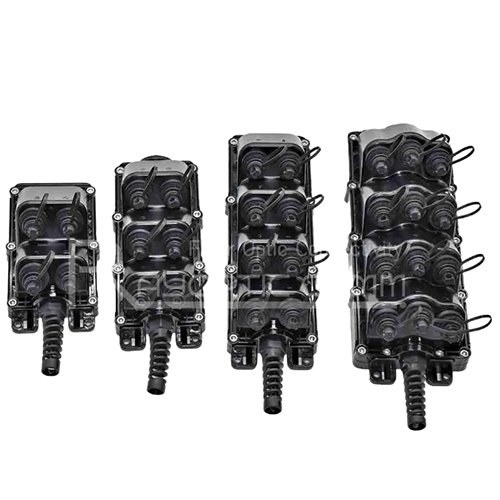
What Is a Fiber MST Terminal?
A Fiber MST terminal is a hardened outdoor fiber access enclosure designed to distribute optical signals from a feeder fiber to multiple subscriber drop cables. It is a core component in Redes FTTH, commonly deployed in aerial, pole-mounted, wall-mounted, pedestal, and handhole installations.
To better understand how MST fiber terminals are applied in FTTH networks, you can also read our earlier article explaining deployment scenarios and installation benefits:
Qué es un terminal de fibra MST y cómo simplifica la implantación de FTTH
.
When equipped with a built-in PLC splitter, the MST terminal functions as a complete passive distribution node. A single feeder fiber enters the enclosure, where the optical signal is evenly divided by the internal PLC splitter. The split signals are then routed directly to hardened output ports—typically Compatible con OptiTap interfaces—enabling plug-and-play drop cable connections without opening the enclosure.
In simple terms, a Fiber MST terminal allows one incoming fiber to be safely and efficiently shared among multiple subscribers, without relying on external splitters or extensive field splicing.
How a Fiber MST Terminal Works
From a functional standpoint, a Fiber MST terminal with built-in PLC splitter operates through three integrated stages:
- Feeder fiber input
The distribution or feeder fiber enters the terminal through a sealed cable entry, protecting the internal components from environmental exposure. - Internal optical splitting
Inside the enclosure, the PLC splitter divides the incoming optical signal into multiple outputs with predictable and balanced optical performance. - Hardened drop cable output
Each output is routed to a hardened port, allowing technicians to connect pre-terminated drop cables directly in the field.
This integrated design minimizes enclosure access, reduces installation time, and helps maintain factory-sealed environmental protection—key advantages for outdoor FTTH y PON despliegues.

Solución FTTH que ilustra cómo los terminales MST de Rayoptic y los cables de bajada reforzados conectan los hogares a través de una red exterior plug-and-play.
Typical Applications of Fiber MST Terminals
Fiber MST terminals with built-in PLC splitters are widely used in a variety of access network scenarios, including:
- FTTH (Fiber to the Home) deployments
- PON architectures such as GPON and EPON
- Multi-dwelling units (MDUs) and residential communities
- Aerial and pole-mounted fiber distribution networks
- Rural and suburban broadband expansion projects
- ISP last-mile access infrastructure
Their rugged construction and plug-and-play connectivity make Fiber MST terminals especially suitable for large-scale, fast-deployment fiber access networks.
Further Reading (Internal Links)
(The following articles will be published separately and linked here once available.)
- Stub Tail vs Stubless: How to Choose a Fiber MST Terminal
[Internal Link Placeholder] - Fiber MST Terminal vs Traditional Fiber Access Box: Which Is Better for FTTH Networks?
[Internal Link Placeholder]
Why Choose Rayoptic’s Fiber MST Terminal
In real-world FTTH deployments, a Fiber MST terminal is more than just an enclosure—it is a system-level access solution that directly affects installation efficiency and long-term network stability. Rayoptic’s Fiber MST terminals are developed based on practical field requirements and large-scale deployment experience.

4 Port MST Terminal Open View
Key advantages include:
- Factory-integrated PLC splitters for consistent optical performance
- Support for both stub tail y stubless configurations
- Compatibility with OptiTap and other hardened connector systems
- Designed to support scalable FTTH and PON network expansion
- Rugged housing suitable for demanding outdoor environments


 English
 Spanish